Thursday, June 14, 2012

Salem's own "Downton Abbey"

Salem’s Phillips House tells the ‘Upstairs, Downstairs’ story 

By Taryn Plumb |  Globe Correspondent
June 14, 2012

Historic New England’s Jennifer Pustz looks inside the icebox located in the Phillips House kitchen in Salem.
Pat Greenhouse/Globe Staff


Stand in the center of the walk-through closet, and look to one side: A bright dining room furnished with fine chairs and tables, wooden floors covered with decorative rugs, a chandelier dangling above, and walls inlaid with elegant molding.
Now glance to the other side: A kitchen with an enormous stove and soapstone sink, worn brick floors, simple woodworking and fixtures. Dim and utilitarian. No fancy flourishes.
The two rooms in Salem’s Phillips House provide a tangible example of the disparity between early 20th century families and their servants. Cooks, maids, and housekeepers were meant to remain as shadowy, fleeting figures who kept the house in order behind the scenes, rarely seen and never heard.
Jennifer Pustz, of Historic New England, has dedicated herself to bringing form to these silhouettes, to giving voices and stories to the servants who so often remained anonymous. She has done extensive research throughout Historic New England’s 36 properties, including at the 1821 Phillips House on Salem’s Chestnut Street, unearthing the artifacts of domestic American life.
“Bringing people out of the shadows creates a full story,” said Pustz, who wrote the 2010 book, “Voices from the Back Stairs."
In the case of the Phillips House, that story includes not only owners Anna Phillips, her husband, Stephen Willard Phillips, and their son, Stephen, but their first-floor maid, Delia Cawley, their cook, Bridgit Durgin, and Caddy Shaughnessy, their nursemaid and attendant. They also employed two part-time male staff: coachman, gardener, and handyman Cornelius Flynn, and chauffeur Patrick O’Hara.

 A cast-iron stove in the laundry room in the Phillips House.
Pat Greenhouse/Globe Staff

The Phillips bought and renovated their home in 1911, and it stayed in the family until the 1970s. The museum focuses on 1919 and 1920.
According to Pustz, the 11,500-square-foot, three-story gray mansion with black shutters is particularly interesting. Unlike other museum houses where servants quarters were later cleared out, renovated, or turned into office or storage space, its staff spaces have been relatively well-preserved.
In addition to its large soapstone sink, the kitchen still contains the Walker and Pratt cooking stove, a wall of glass cabinets, and gas-electric light fixtures.
Through a door at the back of the room and down a set of rugged wooden stairs is the basement laundry room, with a long sink set with wringers and washboards, a stove loaded up with irons, and a set kettle used to boil clothes.
“It was a really messy, hot, sticky, long, job, and physically taxing,” Pustz said.
Going up from the kitchen is a long, narrow, rather ominous staircase to the third-floor servants quarters. The three small bedrooms are empty and unfurnished, but scratches on the floor and marks on the wall tell of the life that was once there.
Back on the main floor, a china closet separates the kitchen from the rest of the house, with its exquisitely furnished bedrooms, parlor, library, and dining room.
Yet although the servants were very deliberately separated from all this, they were never truly alone. As Pustz noted, theirs was a 24-hours-a-day, seven-days-a-week job.
“There was a constant amount of work,” she said.
A call-bell system installed by the Phillipses was common at the time, but remains an uncommon artifact, as they were often removed from historic houses during later-century renovations. Doorbell-like buttons in nearly every room of the house were wired into boxes high on the wall of the kitchen and on the third floor; when pressed, a loud bell would ring and a flag would fill a round circle underneath room indicators, such as the “library,” “parlor,” or “dining room.”

 The bright, well-appointed dining room in the Phillips House in Salem provides a contrast to the living quarters of the servants and the areas of the house in which they worked.
Pat Greenhouse/Globe Staff

Even though it meant the staff had to stop everything and attend to the call, “it was an incredibly efficient way for them to work with the family and meet their needs,” said site manager Julie Arrison.
Although the relationship the Phillips family had with their servants was rather harmonious compared with other households, according to Pustz, clearly defined barriers separated the two halves of the house.
For example, Arrison said, just what to call them was a “sticking point” for the family — they were referred to as “the staff” or “the girls,” rather than “servants.” Meanwhile, anecdotes — such as Mr. Phillips’s propensity for stepping to the threshold of the kitchen, but never going inside — stress just whose domain was whose, and who should be where, and when.
On the other hand, although the servants heard and saw almost everything that was going on, “they were expected to be invisible. It was a very complicated visibility/invisibility,” said Pustz.
Ultimately, in exploring and presenting all that was found, the goal is to create a “balanced perspective of what living here was like,” she said. “It was two worlds under one roof.”
By telling all the stories of a house – or at least attempting to by piecing together the scant bits of history — “it adds to the overall narrative of New England’s history,” said Peter Gittleman, visitor experience team leader for Historic New England. “Everyone’s history matters.”

 A call box in the Phillips House kitchen was used to summon servants to a particular room.
Pat Greenhouse/Globe Staff

To that end, Historic New England also is unveiling a new, permanent installation this month at the Spencer-Pierce-Little Farm in Newbury. It looks at the Stekionis family, natives of Lithuania, who lived in a tenant farmer house on the property from the 1920s to the 1990s, raising food for the Littles.
Gittleman said it is just another example of the many narratives beyond those of the “rich and famous” property owners to be discovered in any given place.
“The stories are much more nuanced when you look at them from multiple perspectives,” he said.
Pustz agreed, stressing that, when analyzing history, people need to be aware that there were “all kinds of layers and relationships,” and there are also many things we’ll never know, no matter the amount of digging into research.
Ultimately, she said, our shared past isn’t neat and linear, easily fitting into timelines and generalizations.
“History is a really messy, complicated thing,” she said. 

The Phillips House in Salem.
Pat Greenhouse/Globe Staff

How does $5 a week sound? For circa 1919 servants in Salem, that was high pay

At the Phillips House circa 1919:

5
The number of servants employed by the Phillips family: 3 full-time women, 2 part-time men.

$5
The weekly wage of Delia Cawley, longtime maid for the Phillips family.

$3
Cawley’s weekly wage at her previous job.

100
Years (combined) that Cawley and maid/attendant Caddy Shaughnessy worked for the Phillips family.

SOURCE: Historic New England


Monday, June 11, 2012

It Takes a Town

One town spells upkeep D-I-Y

Carpenter Dan Savage of B&N Development installs white cedar shingles on Newbury Town Hall. Volunteers are helping the town save money on repairs. 

(Photos by Pat Greenhouse/Globe Staff)  

By Taryn Plumb Globe Correspondent / June 10, 2012 

NEWBURY — As the saying goes “it takes a village,” and in Newbury’s case, not only to raise a child, but to raise a building.
With the the perennially tenuous budget-balancing act — and the defeat of two consecutive overrides, $950,000 last spring and $293,000 in May — officials have turned to community kindness, rather than the tight town coffers, to perform much-needed municipal repair projects.
During the past several weeks, volunteers from Newbury and beyond have donated time, expertise, money, and materials to renovate the Town Hall and library.
“There’s been overwhelming support,” said building inspector Sam Joslin, who has overseen the effort.
Work on the two-story, 2,400-square-foot Town Hall has included replacing worn and weathered siding and rotted exterior trim; landscaping and rebuilding of a retaining wall; and interior painting, reflooring, and furniture updates.
“It was in pretty desperate need of a makeover,” said Joslin.
The exterior of the 14,000-square-foot library, meanwhile, is being repainted (the same color — gray with red trim).
Work on both buildings was expected to be completed last week, weather permitting.
More than a dozen local businesses, restaurants, and agencies came forward to offer labor crews, tree-removal and landscaping services, and materials such as paint and lumber. They included the Essex County sheriff’s office, Jackson Lumber and Millwork in Amesbury, and Hathaway Landscape Co. of Newbury. Plum Island Grille and Bob Lobster, both in Newbury, also donated food for the workers.
Greenscape Property and Building LLC of Newbury, for its part, shingled one side of the Town Hall and sheathed holes where air conditioners once butted out, according to owner George Haseltine.
Brett Murphy of Newburyport-based Murphy Construction Company, meanwhile, supplied carpenters who spent three days residing one side of the building.
He called the response “tremendous,” noting that Newbury is a “close-knit community, and everybody wants to pitch in.”
Haseltine agreed, saying that, as a resident himself, he felt compelled to contribute.
“I believe that, in the economic climate that we are in, we all need to work hard to help each other out,” he said in an e-mail. “Now when people drive by or visit the Town Hall — either residents or nonresidents — they can appreciate the effort that many community members put forth.”
Donated or reduced-price labor and materials saved the town hundreds of thousands of dollars. Joslin estimates the Town Hall renovations would have cost between $150,000 and $200,000, and the library project would have had a price tag of about $62,000. But the town will pay just about $22,000 for both out of an account set aside for capital improvement projects.
“There’s a lot of willingness in this town,” said Joslin, seated in his Town Hall office on a recent afternoon, the building’s exterior still set up with staging and tarps, and its driveway partially covered with mounds of dirt and landscaping stones. “I don’t think we’ve found a way to focus that interest in a while.”
That energy was first directed to a shared purpose after Joslin, in 2008, closed the Department of Public Works facility because it was out of code and in disrepair.
Estimates of roughly $500,000 to rehabilitate it were “well out of the town budget,” he said. As a result, the building was left empty and the department “had no home for a couple of years.”
But then, people started coming forward to offer help — and within six months, all five garage doors had been repaired and the building was equipped with a new roof and gutters, as well as new wiring, windows, and heating, ventilation, and carbon monoxide detection systems. The project was completed in late 2010, and ended up costing the town about $150,000, Joslin said.
“The building was condemned — it was an extremely dramatic change,” he said. “It was pretty amazing that we had that much of a response.”
Town officials don’t expect to stop now. They have since reinstated a capital planning committee, and Joslin has taken on the role of facilities manager.
The next project? Tearing down and rebuilding a two-bay Department of Public Works garage.
The hope is to start this fall, or by the spring at the latest, depending on the availability and willingness of volunteers.
“With some cooperation, planning, and proper funding,” Joslin said, “we can do quite a bit.”

Community support by the numbers

$762,000
The estimated cost to renovate the Newbury Department of Public Works facility, Town Hall, and library.
$172,000
The actual (rough) cost to the town for all three projects.
Two dozen
The number of local contractors, landscapers, lumberyards, restaurants, and schools that donated time, money, or materials for the three projects.
A month
The amount of time it took for volunteers to complete work on the Town Hall and library.
$1.243 million
The amount turned down by voters in override questions last spring and this spring.

 © Copyright 2012 Globe Newspaper Company.

Monday, June 4, 2012

Silent films resonate in the 21st century

Pianist accompanies vintage silent movies for a modern crowd

THIS STORY APPEARED IN Boston Articles 
June 03, 2012

Taryn Plumb/Globe Correspondent
  • Hudson resident Richard Hughes provides the musical accompaniment for the 1927 silent film It, featuring Clara Bow, for             a recent community gathering in Stows Old Town Hall.
Mark Wilson for the Boston Globe

Up on the screen, in black and white, a vivacious starlet projects not with her voice or her body language but with her entrancing eyes.
They widen and shine with happiness; lower and smolder with desire; pop and flame with anger; droop with sadness.
As silent film siren Clara Bow captivates, pianist Richard Hughes follows: Low notes greet her sorrow, high ones her cheer; down-the-keyboard trills reflect her flirty, playful nature.
“I’m reacting to the screen,” said Hughes, who makes a living in nostalgia: The 62-year-old Hudson resident is a pianist in the old-fashioned, nearly forgotten art of silent film musical accompaniment.
Silent movies evoke a different time — one that wasn’t necessarily simpler, as the cliché goes, but uncertain, like ours, and for many of the same reasons — and they also offer a respite from the cacophany of contemporary cinema.
And even in today’s instant-access, frenetic culture, they continue to captivate: Just look to the popularity and success of last year’s silent French film “The Artist,” which won five Academy Awards, including those for best picture, actor, and director, or the rerelease of the colorized, re-scored 1902 “Le Voyage dans la lune.”
Hughes serves as a sort of tour guide to this slower, subtler world, as he accompanies various silent films — from Buster Keaton slapstick shorts to feature-length narratives starring the quintessential flapper girl Bow — in showings at local schools, libraries, senior centers, historical societies, private clubs, nursing homes, and assisted living facilities.
As he put it, the medium endures because the same themes — betrayal, triumph over adversity, love lost and found again — transcend time and place, whether it’s the ancient Greek theater, the burgeoning post-World War I movie theater, or the 21st-century multiplex. All that changes is the manner in which it’s presented.
“One thing remains absolutely the same: our emotions,” Hughes said.
Because technical challenges prevented the recording of synchronized sound and film until the late 1920s, theaters almost always had an organist or pianist accompanying silent film reels, either playing scores of their own creation or cobbling together “little clips and bits” of music written by others, Hughes explained. Popular songbooks, meanwhile, provided “moods” that could be applied to any movie.
As Hughes noted, comedy scores are much more “jaunty and light,” and are played in a “more staccatto way, more cavalier,” with more space between the notes. Darker movies, on the other hand, have “muddier” scores, with lower and often more sustained notes.
But whatever the film, improvisation is a key component, according to Hughes.
“It’s very difficult to play something exactly’’ as composed, he noted.
“You have to build in transitions or bridges from one piece into another.”
His interest initially piqued by a piano teacher — he had fiddled on the keys since age 7, and always liked silent films, particularly “Keystone Kops” shorts — Hughes started looking into the craft 15 years ago after he was laid off from his precision manufacturing job. After some research, he found the book “Motion Picture Moods for Pianists and Organists,” by Erno Rapee, originally published in 1924.
“This is my bible right here,” he said, laying it down on his kitchen table.
On its well-worn and dog-eared pages are more than 50 “moods,” ranging from “sinister’’ to “hunting,” to “aeroplane.”
As he learned to play them, he created his own cue sheets to synch with the onscreen action. He’s also scored original compositions for several Charlie Chaplin shorts, and hones his “moods” and themes on an 1895 Hallet, Davis & Co. grand piano in his living room.
Not surpisingly, he’s particularly fond of Chaplin, “the little tramp” who started in vaudeville, and went on to become one of the most successful and enduring silent film stars.
“He had depth to his character: He was so crass one second, and in the next filled with compassion,” Hughes said. “He was probably the best pantomime comedian who ever lived. He left a huge legacy.”
Buster Keaton , meanwhile, best known for his dangerous stunts, physical comedy, and outrageous sight gags — all endured with his “great stone face” — is another Hughes favorite.
“Even nowadays he’s a real crowd-pleaser,” said Hughes. “People want to laugh.”
Indeed, guffaws and titters rippled across the room as Keaton scaled trucks, plunged through open windows, and sent pursuing cops colliding into one another during a recent screening of 1921’s “The Goat” as part of the annual SpringFest in Stow.
The goofs were followed up by romance: 1927’s “It,” starring feisty Jazz Age bombshell Bow.
“Secretly, I’m in love with Clara Bow,” Hughes told the crowd of several dozen assembled in Stow’s Old Town Hall, describing the movie as “a Cinderella story” and “one of the first chick flicks.”
Based on the book by Elinor Glyn, the film follows Betty Lou (Bow), a shopgirl, and Cyrus Waltham (Antonio Moreno), the owner of the store where she works. The pair fall in love, but a misunderstanding splits them apart — until the end, when they’re back in each other’s arms again.
As popcorn popped, the music flowed with emotions: buoyant and trilly; elegant and elongated; swanky; dreamy; somber.
s he played on a keyboard hooked up to a portable sound system, Hughes tapped his black-and-white wingtips, swayed and bobbed his shoulders.
“It’s just different, something people aren’t used to seeing,” Lewis Halprin, who organized the event through the Stow Lions Club, said after the requisite “The End” filled the screen. “They’re used to full-color 3-D. But you can get a perfectly good experience with black and white, and no sound at all.”
Audience member Bob Walrath recalled how, as a kid, going to the movies was a “regular Saturday afternoon thing.” (For him, the draws were Gene Autry and Roy Rogers.)
It was just part of your normal routine,” he said.
Hughes agreed, noting that what’s been lost in the late 20th and early 21st century is the communal aspect of cinema.
In the beginning, “it was more of an interactive thing, a community thing,” he said.
Ultimately, “silent movies are fun,’’ Hughes added.
“They’re educational. It’s an opportunity to glimpse what life was like back then.”
Ultimately, “silent movies are fun. They’re educational. It’s an opportunity to glimpse what life was like back then.”

© 2012 NY Times Co.

Thursday, May 17, 2012

Sole support

Soles of appreciation

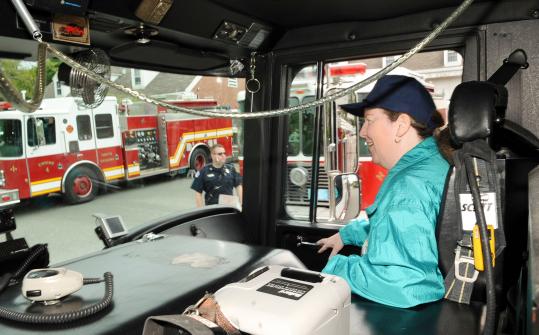
Donna Picone gets a quick ride on a North Reading firetruck after walking to the main station from her Danvers home last week. 
Donna Picone gets a quick ride on a North Reading firetruck after walking to the main station from her Danvers home last week. (Photos by Lisa Poole for the Boston Globe) 
 
By Taryn Plumb Globe Correspondent / May 17, 2012 

As many people do on crisp, sunny mornings, Donna Picone laced up her Sauconys, grabbed a bottle of water, and set out for a walk with a close friend.
But this was no ordinary get-the-blood-moving, enjoy-the-outdoors stroll: The women were in for a nearly 9½-mile trek from their Danvers neighborhood to the North Reading Fire Station.
They weren’t training for a sporting event; they weren’t raising money for a cause; and they didn’t have too much time on their hands.
Their many footsteps served a different purpose: To raise awareness of the dangerous job firefighters do, and to show their appreciation by donating one of the most precious things a person can: time.
“Everybody can raise money for a charity,” said Picone, 55, who has made it a personal quest to visit as many fire stations north of Boston as possible by foot or, if she has to, by car. “I give the support by walking the miles.”
Over the past six years, Picone has walked from her Danvers home to fire stations in 15 area cities and towns, from her old hometown of Salem all the way to North Andover.
Last Friday, she logged several more miles on her silver-and-turquoise walking shoes when she and her friend, Patti Lynch, meandered down Route 62 to North Reading.
In September, she plans to lace up her shoes and head south to Lynnfield’s two firehouses.
And next year? She’s considering Topsfield and Boxford (one in the spring, one in the fall). Eventually, her goal is to cover the whole region.
“I enjoy giving them my time,” she said.
It was the Worcester Cold Storage Warehouse fire — and the deaths of six firefighters battling the blaze — on Dec. 3, 1999, that inspired her crusade.
“It was a senseless tragedy,” she lamented.
Having several relatives on fire forces — including her late uncle, John Monahan Sr., who was a captain; his son, John Monahan Jr., also a captain in Salem; and another uncle, Charles Jodoin, a Revere firefighter — profoundly affected her, and reinforced how dangerous the job is.
But before walking, she drove. She started in 2000, and has visited hundreds of stations in Massachusetts and New Hampshire, as well as about 30 in California and Florida while on vacation.
She realized she could make more of an impact with her soles than with wheels, and she did her first walk, to Salem’s five stations, in September 2006 with her sister, Gail Corsetti.
Since then, first with Corsetti, then with her friend Karen Shah, and now with Lynch, 59, Picone has visited the fire departments in Beverly, Danvers, Gloucester, Hamilton, Ipswich, Manchester-by-the-Sea, Marblehead, Middleton, North Andover, Peabody, Rowley, Swampscott, and Wenham. She typically tries to walk to two communities a year, one in the spring and one in the fall, prefacing the visits with handwritten letters to their chiefs.
In between, to stay in shape, she walks about 1½ miles every day through her neighborhood, listening to the birds and watching planes descend to Logan Airport. She’s a bit of an aviation enthusiast; she has a 28-inch-long model airplane in her basement, and can point out the types of commercial aircraft passing overhead.
Because she’s been to so many stations — and because she’ll often stop in on a whim when driving through a place, as she plans to do this summer while visiting Cape Cod — it’s hard for her to give an exact number. That’s not what she keeps track of: She keeps track of the thanks, the hugs, and the appreciation she receives when she reaches her destinations.
At each station, she meets and talks with firefighters, is usually given a tour, and hands out tokens emblazoned with a firefighter emblem on one side and a prayer on the other.
“It does mean something to them,” she said. “It helps them realize that people appreciate what they do.”
This is a point she stressed to members of North Reading’s force last Friday.
It was 60 degrees when she and Lynch set out just after 9 a.m.
They were equipped with two bottles of water, peanut butter crackers for a snack, Excedrin for headaches, sunglasses, and a small plastic bag filled with the tokens.
They first passed through their manicured neighborhood on the edge of the Putnamville Reservoir (starting off from Picone’s house with its fire engine mailbox hand-carved by her father), then worked their way west on Route 62.
As the road wound along — in a couple of places sans sidewalks — the pair passed houses, schools, businesses, sloping fields, wetlands, and country clubs; investigated lilac bushes; and dodged poison ivy.
At 12:45 p.m. — 3 hours and 45 minutes later — they turned the bend into North Reading Center.
At the station, firefighter/EMT Matt Carroll met Picone and Lynch, shaking their hands.
“We appreciate what you did,” he said as he invited them in.
The rest of the men in the station — five in total — gathered around as they talked.
“I love what you people do,” Picone said as she handed out the tokens. “I have since I was 5 years old.”
It was then, she recounted, that she learned just how quickly firefighters respond to a call. On a dare from a boy, she pulled the switch on a firebox. Instantly terrified, she threw her bike on the ground, sprinted home, grabbed some cookies, and hid in a closet. All the while, the sirens got closer, and the engines arrived within minutes.
Carroll, in turn, shared the burdens of the profession.
“It’s a stressful job, that’s the truth,” he said. People are having “their worst day in a long time when they call you. You absorb a lot of other people’s stress.”
Then the men led Picone and Lynch on a tour of the 1967 building, which operates with four engines, two ambulances, and one ladder truck. Carroll showed off a mural of firefighters climbing a ladder into a blinding cloud of smoke, then took the pair into the truck bay lined with flaming red lockers, one or two ajar to reveal a jumble of gear and photos of daughters and wives.
Before she left, Picone even got to ride around the block in a firetruck, fulfilling a longtime wish.
“We get thanks a lot on the job,” Carroll acknowledged later as Picone prepared for the trip back (by car; her parents picked them up). “But when people go out of their way, it makes it a little more special. What she’s doing is simple, but effective.”

Monday, May 14, 2012

The end of an era?

  • The liquidation sale at MovieWorks is expected to last until the end of June, with more than 30,000 titles available at its             start.(David L. Ryan/Globe Staff )

Renting the last picture shows

May 13, 2012 | Taryn Plumb, Globe Correspondent
 
For Jesse Kreitzer, the click-access, browse-from-your-couch-or-computer, instant-gratification movie rental trend that dominates our time is a “soulless” experience.
He’d much rather peruse aisles neatly lined with DVDs — you can pick them up, turn them over, marvel at the cover art, maybe even find something you never expected.
“It’s an immersive, first-hand experience,” said the 27-year-old Brighton filmmaker, noting that a visit to the good old-fashioned video store has become part of his weekly routine.
For not much longer, however: His favorite rental shop, MovieWorks on Beacon Street in Brookline, is in liquidation mode, and is set to close by the end of June. The well-known and long-respected establishment, which had more than 30,000 titles before owner Greg Revill began selling off its inventory late last month, was one of the last remaining brick-and-mortar video outlet not only west of Boston but in the state.
“Now I don’t know what I’m going to do,” lamented Kreitzer, acknowledging that he’s a bit of an “old soul.”
“It’s like the end of an era for me.”
But not just for him: MovieWorks was a longtime holdout in what has been a protracted extinction of physical video stores.
Among area communities, Video Signals in Acton and Stow appears to be the lone survivor. Elsewhere, just a smattering of Blockbusters remain, including in Malden, Lawrence, Haverhill, and Worcester. Meanwhile, the 25-year-old Hollywood Express in Cambridge, the Video Underground in Jamaica Plain (around since 2002), and 20-year-old Chet’s Video in Marblehead are the handful of independents still in operation.
This is in startling contrast to the scores of stores — both chains and independents — that were so evident throughout suburbs and cities not a decade ago.
In late 2010, the lights went dark on Video Vault in Westborough; Video Exchange Inc. in Marlborough, in operation for 30 years, appears to be another casualty (its website is down and its phone number disconnected).
Lexington Video — formerly Videosmith — was also shuttered last month, a little more than a year after it was taken over by a new owner, Sue McDonald.
McDonald did not return requests for comment, but her website notes a lack of investors and an inability to keep up with rental costs, despite a concerted community investment effort.
“I am very sad that I have to do this,” she writes on her store’s website, www.lexingtonvideostore.com, “since the business was just starting to see real improvement.”
All told, the number of video stores across the country has declined to a quarter of its peak. In 2003, there were 25,000; by the end of last year, there were just about 5,800, according to Michael Arrington, a senior analyst with an industry research and consulting company, IHS Screen Digest.
Meanwhile, Blockbuster, one of the only national chains remaining, topped out at roughly 5,700 stores. But with Blockbuster’s recent acquisition by Dish Network, Arrington said, its number will fall below 1,000 by the end of the year.
On the other hand, video rental kiosks — most notably Redbox — are approaching 50,000 locations nationwide, Arrington said, while the mail-order Netflix operation has 26.1 million US subscribers, and 23 million subscribers to its online streaming video service in North and South America, England, and Ireland, according to financial reports.
MovieWorks, for its part, was doing several thousand rentals a week at its peak. Most recently, it continued to do close to 1,000 a week, and had even taken on some new customers, but the numbers just didn’t work, according to Revill. The Salem resident also ran a MovieWorks store in Danvers, which he closed in late 2010.
“Business has been slip-sliding for a long time,” he said.
A number of factors contributed to a slow decline of what was once a voracious “rental habit,” he explained.
Most notable are Netflix and on-demand services, along with the recent proliferation of Redbox kiosks offering 1.20 a night rentals, as well as multiplying cable television channels.
The impending closure of MovieWorks has spurred quite a few queries of “what happened?”, Revill said, with one woman saying she was feeling abandoned. The Brookline location has been a video store since 1989 and became Movie­Works in 2000.
“Everyone’s disappointed,” said Revill, standing at the store’s central counter on a recent weekday afternoon. “Some are not surprised. Some are utterly shocked.”
On the walls around him, yellow fliers advertised DVDs for 20 percent off, and Blu-rays for $12 and $15. Out front a yellow “Going out of Business” banner was on display.
Customers dribbled in to pick through the substantial amount of stock that remained. On a flat-screen TV at the back, “Alvin and the Chipmunks: Chipwrecked” played on a continuous loop.
At the end, “the regulars were a smaller group than they ever were,” Revill explained. “The occasionals were very occasional. People tend to forget it’s an option.”
Then just how did his store hold on for so long?
Momentum from past success, according to Revill, as well as a “kind and gentle landlord,” and the store’s vast inventory. (Also, its pricing was less than that of Redbox: $4.75 for a DVD for six days, and specials like two-for-one rentals every Monday.)
“This place functioned like a pay film library for a lot of folks,” particularly film students from Boston’s many colleges, said Revill.
The highest percentage of the store’s business was from its catalog of older films, rather than the new releases, which Revill said helped it to outlast the “hall of hits” stores.
And Arrington, for his part, doesn’t think the model is totally obsolete.
He pointed to the Illinois-based Family Video chain, which has 765 stores in 19 states, according to its website, and which, “by all accounts, is doing quite well, and is actually expanding,” Arrington noted.
A successful 21st-century video store will come down to an ability to compete, be conservative with spending, and contain costs. “Just running your business effectively is the key,” Arrington said.
Still, he does expect to see a continued decline in the brick-and-mortar industry: Traditional video stores slid from $8.5 billion in revenues in 2001 to less than $1.4 billion last year, and he expects the total to fall below a billion dollars over the next five years.
But there could ultimately be a “stabilization point,” he noted. “I think there’s a future for video rental stores, but it’s a very small future.”
Revill agreed, saying that the now-nostalgic video store will always be a lure for some.
“What people love about these places is the tactile, visual, finding-stuff-by-accident appeal,” he said.
That’s certainly what kept Kreitzer going back.
“I’m a bit of a purist,” he said. “I like the physicality of renting discs.”
(And that affinity for the good old-fashioned way permeates his life, from his collection of vinyl records to his preference for shooting his numerous projects — including a feature-length film, “The Wake” — on film.)
Renting from MovieWorks three times a week on average, he would always find “obscure and very hard-to-find independent and foreign films,” Kreitzer said. In the process, he’d banter with the staff and came to learn and trust their tastes.
“It is to me much more than a video store. It’s a subculture,” he said. “It’s just all part of something that will go missing.”

Monday, May 7, 2012

MetroWest495 Biz April 2012

The annual "10 to Watch" list starts on page 12. 
And a story I did on Marlborough development starts on page 20. 
Go here to check out the e-edition.

Artscope Magazine May issue

Read (some of) my article on Portland's Greenhut Galleries here. And buy a copy to read the rest! (Go here to do that.)