Thursday, October 2, 2014

These aren't your father's model planes

Model plane enthusiasts zoom into the wild blue yonder

By Taryn Plumb | GLOBE CORRESPONDENT
OCTOBER 02, 2014


The three jets line up side by side on the runway, then take to the air with a collective, thunderous roar.
Commanding the sky, mocking gravity, they spiral, dip, and weave in every direction. Soar straight up until appearing as mere blips in the clouds before rocketing back down. Fly parallel to the ground at full speed, trailed by the piercing whoosh of their engines.
Necks are craned and eyes shielded from the sun to watch the spectacle, and, when several minutes later they come in for a landing, they are met with applause and acclamation.
But this isn’t your typical air show — and you’ll not recall Tom Cruise piloting these high-powered machines in “Top Gun.”
They’re radio-controlled model planes, but generations evolved from the kind you might remember tooling around with — and crashing — as a kid.
“It’s expensive to fly a full-sized aircraft,” said Bob Gettler, president of 107th Radio Controlled Flyers, one of several local model clubs. With model planes, you don’t spend nearly as much money and yet, as he put it, “You get the thrill of flight.”
While they might be small and portable, toys these are not. Enthusiasts spend anywhere from a few hundred to thousands of dollars to equip, repair, boost, and accessorize their models, whether Cessnas, biplanes, warbirds, helicopters, or even jets. With wingspans ranging from several inches to several feet, some planes run on a special blend or kerosene for fuel, while significant developments in battery technology have enabled others to become increasingly like their full-size counterparts.
A lot of aerospace technology has made it into models,” Gettler said as he stood by the edge of his club’s runway at Rumney Marsh Reservation in Saugus, a windy, wide-open location just a blip in the guardrail along Route 107.
Nearby, model planes of various sizes took off, landed, and coursed through the air. “The hobby’s definitely grown a lot in the last 10 years,” Gettler said.
In addition to the 107th RC Flyers, formed 30 years ago and now with about 100 members, other local groups chartered by the national Academy of Model Aeronautics include the Cape Ann RC Model Club, which flies at a field in Amesbury; the 495th RC Squadron, which holds events in Tewksbury, Billerica, and on Plum Island; and the Middlesex County RC Flyers, which also uses a field in Billerica. Hobbyists meet and trade tips at local, regional, national, and international rallies held throughout the year.
Peabody resident John Almeida regularly loads his Boomerang jet into an RV for vacations planned around various shows.
It’s a big-boy sandbox,” said Almeida, 49, crouched by his jet as it cooled down after several minutes of air time at 107th RC Flyers field.
Modelers love to build, maintain, and tinker, he said. “It puts a smile on a grown man’s face.”
Measuring roughly 8 feet long and 8 feet wide at the wings, weighing nearly 40 pounds and painted a patriotic red, white, and blue, his jet is powered by a turbine that requires a kerosene start and has two on-board systems for safety. Considered the elite fliers of the radio control world, model jet pilots must prove their proficiency to the Academy of Model Aeronautics to legally fly.
Almeida has always been into modeling, he said. As a kid he liked boats, then moved on to propeller planes, and now the jet, which can scream through the sky at up to 160 miles an hour.
Mentally, you’re exhausted after one minute of high-speed flying,” he said. “The challenge never stops. The maneuvers can get smoother, better, tighter.”
Nearby, Gettler was preparing his red and yellow Trex model helicopter for liftoff. Holding a remote with a digital readout, he ticked through the controls of the battery-powered aircraft.
He explained that all models get a preflight check, just like the big ones.
Everything’s good to go; all controls are working correctly,” he announced, and the helicopter’s carbon-fiber propellers whirred to life.
With just slight directions on the controls, the miniature chopper zipped through the air, flew upside down and backward, flipped, rolled, looped, pirouetted, and hovered.
A program manager for General Electric, Gettler, 32, who lives in Salem, has been flying models since college and now has three helicopters, a jet, and an aerobatic plane. He also has his pilot’s license, as well as “some time” in a full-sized helicopter, he said. He volunteers teaching an aerodynamics course at Kipp Academy in Lynn.
I just have a love of aviation,” he said, calling remote-control flying therapeutic and “like meditation.”
All around him, various models were set up on platforms, while others were being tinkered with, or lining up on the carpet runway, engines buzzing. Onlookers sat beneath tents, and the occasional flock of swallows or a roving turkey vulture careened out of the path of the swooping and diving planes. Gettler said the rules limit the height for flying to 400 feet, and only four aircraft can be up in the air at once.
On the sidelines with their remotes, pilots yelled out status reports.
Landing!”
Taking off!”
I got no power — I’m dead!”
Earlier, Geoff Caldarone suffered what he called a “class A mishap,” when one of his planes crashed and a wing fell off.
Crashing is part of the hobby,” the 51-year-old engineer from Danvers said with a shrug.
Sitting on a pedestal next to him was a 2-pound foam warbird with a 44-inch wingspan, “Dallas Darling” painted on one side. Warbirds are his personal favorite, Caldarone said; he can perform rolls, loops, and Immelmann turns, “flying evasive maneuvers to get behind an enemy to shoot it down,” he said.
It’s a great hobby. I’m in it deep now.”

Original story link

Peering into the past

Hingham’s glory days as ‘Bucket Town’

By Taryn Plumb | GLOBE CORRESPONDENT
SEPTEMBER 28, 2014


For more than a century it sat relatively untouched, shuttered up and vine-covered, on an 18-acre Hingham farmstead passed down through generations.
Finally, one day, a rusted lock was removed, the vines cut back, and the door of the wooden shed groaned open to reveal a preserved world. Cluttered inside, through the dusky light of its windows and beyond the dust and spider webs, were all manner of tools, raw materials, patterns, account books, and toys and boxes in various states of completion.
It was a rare and extraordinary find: one of Hingham’s last woodcrafting shops, and one of the oldest toy-making workshops in America, sitting unassumingly on a pasture on the Hersey estate.
It was very much a time capsule,” said historian Derin Bray, author of “Bucket Town: Woodenware and Wooden Toys of Hingham, Massachusetts, 1636-1945.”
Now, many of the long-hidden artifacts found within – along with numerous other antique woodcrafts spanning various eras – are on view for the first time in “Bucket Town: Four Centuries of Toymaking and Coopering in Hingham,” an exhibit at Old Sturbridge Village meant to honor the town’s illustrious and prolific woodworking past and its wide-ranging impact. Curated by Bray and Christie Jackson, the show will be on display through Jan. 18.
Hingham was the woodenware capital of Colonial America,” said Bray, who is based out of Portsmouth, N.H. “These craftsmen were so prolific, their items ended up all over the country.”
Located in the living history museum’s visitors center, the exhibit includes more than 180 items from the Hersey family as well as private collectors and historical societies and museums.
The idea was to focus on individual makers and folks who became so prominent in the field,” said collections manager Rebecca Beall.
That includes the town’s first cooper, Thomas Lincoln, who settled in 1635, as well as other respected craftsmen such as William Luce, Loring Cushing, and Augustus Hudson.
The Hersey family, who first settled in town in the 1730s, was among the most influential of Hingham coopers, a term dating to the 14th century and referring to the craft of making, repairing, furnishing, or fixing. Patriarch Reuben Hersey and his sons and grandsons were joined by hundreds of other artisans, establishing Hingham as the woodenware hub of early America, and earning it the distinction of “Bucket Town” – after one of its most prolific exports.
Their specialty was wooden buckets,” said Bray. “They produced tremendous quantities of them, tens of thousands.”
Generally speaking, the focus was on lightweight containers – pails for milk and water, tubs for curing meat or laundering – as Bray explained, “any kind of wooden container that you could conceive of,” that were then shipped to Boston, down the Eastern seaboard, and as far away as Canada, Hawaii, California, and even the West Indies.
Hingham’s coopers also played a pivotal part in the Revolutionary War, producing in 20 days 5,000 canteens, drinking vessels that remained a staple of the US Army for years.
The industry flourished so much, that, in 1687, the town paid its tax bill to the general court in Boston with surplus milk pails, according to the exhibit. Similarly, according to a newspaper account from 1818, 500 men, or 38 percent of the total male population, were engaged in woodworking. (Hingham’s population in 1820 was 2,857, according to the 1893 book “History of the Town of Hingham, Massachusetts” — compared with 22,157 in 2010.)
The introduction of steamship service between Boston and Hingham in 1819, as well as the arrival of mechanized tools in the 1830s, further fueled the industry.
But out of everyday items soon came toys: With steamship service proliferating by the late 18th century, coopers began making miniature versions of their goods to sell to tourists.
With that market taking off, William Tower opened one of the country’s first toy factories in Hingham.
The practical wares and their more whimsical counterparts are juxtaposed side by side in the exhibit.
Buckets range from the size of nickels to full-sized basins water-stained and nicked by time, and vary from well-known “Hingham blue” to red, green, and yellow, some covered with clasps, buttons, and equipped with twine handles, others decorated ever so delicately with tiny flowers or eagles.
Interspersed with them are tiny yellow rockers and chairs no taller than 6 inches; mini desks complete with drawers and knobs the size of pinheads; high-back chairs about a foot high with intricately woven fiber seats; a tiny grandfather clock stuck at 3 o’clock for eternity; and teeny wash stands, towel racks, wash buckets with washboards, and butter churners.
It’s about “being inspired by the craftsmanship,” said Beall, marveling that “when you’re working in miniature, there’s a lot less room for error.”
In a nod to the Herseys, the exhibit replicates the experience of those who first peered into the recently rediscovered workshop by placing many of the tiniest items behind windowpanes.
According to Bray, the property has been passed down through six generations, and the family began cleaning it up in 2007. The workshop, which has been dated to 1835, had been overgrown for years, and, once they got inside, the process took a great deal of “pulling out and cleaning out 150 years worth of accumulation.”
That included account books with impeccable handwriting, all manner of tools, stamps, clamps, molds, as well as personal items such as tobacco, tea tins, liquor bottles, and a photograph of Abraham Lincoln and his family (the Herseys were related to the Lincolns by marriage).
The family eventually hired Bray to research their history, a project he worked on full time for a little more than three years, he said, studying tax, property, and court records, probate inventories, visiting historical societies, public libraries, museums, and speaking with private collectors.
Eventually, they approached Old Sturbridge Village – as opposed to the much closer Plimoth Plantation – because its focus on the late 18th to mid-19th centuries fit with the most prolific period of coopering and toy-making in Hingham.
The topic is right in their wheelhouse,” said Bray.
But why did Hingham come to such prominence in the woodenware industry?
Bray noted the proximity to Boston, as well as water access and abundant cedar in swampy lands around the town.
But ultimately, it came down to hard work and Yankee perseverance.
Really entrepreneurial, skilled craftsmen developed this network early on,” he said, “and it just grew.”
Bray says buckets haven’t been made in town for more than 100 years, and the toy-making industry petered out by World War II. Today, Lindsay Malone, great-great-granddaughter of Reuben Hersey, makes bucket jewelry (in the shapes of the coopering buckets) that are sold at Whitney Gordon Jewelers in Hingham. The ornamental mementos of the town’s glorious past may be viewed at the website www.buckettown.com.


Hingham earned its ‘Bucket Town’ nickname
SEPTEMBER 28, 2014


►From the 1650s to the 1890s, Hingham woodenware crafters produced thousands of items, earning their home the nickname “Bucket Town.”
►In 1818, roughly 500 men, or 38 percent of Hingham’s total male population, were involved in coopering.
►The Herseys were among the largest and most influential families, settling in town in the 1730s.
►During its heyday, tens of thousands of wooden buckets were shipped from Hingham to Boston, and then as far away as Canada, Hawaii, and the West Indies.
►During the Revolutionary War, Hingham crafters manufactured 5,000 canteens by hand in just 20 days.
►Hingham’s population:
1765: 2,467
1820: 2,857
1830: 3,387
1850: 3,980
2010: 22,157

SOURCES: Derin Bray; Christie Jackson; “History of the Town of Hingham, Massachusetts.”

For more details on the exhibit, visit www.osv.org/buckettown. For details on purchasing Bray’s book, visit shop.osv.org/a543/bucket-town.html.

Photo slideshow by Michele McDonald.

Original story link.

A new avenue for young writers

Worcester Journal
Posted on Oct 1, 2014 in Faculty

Professor James Dempsey launches Worcester Journal, a showcase for young writers


One is a rumination on forgiveness, prompted by the writer’s encounter with an incarnation of the boy who once bullied him.
Another is a poignant remembrance of a 7-year-old girl burdened by the loss of sight.
A third is a treatise on the evolution of Godzilla—a beloved celluloid monster inspired by one the most tragic events of the 20th century: The 1945 atomic bombings of Hiroshima and Nagasaki.
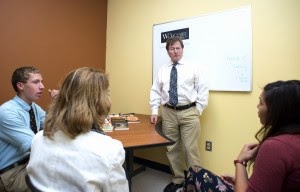
These are just a few of the touching, introspective, humorous, and informative pieces that appear in The Worcester Journal, a new literary magazine dedicated to showcasing the work of young writers. Edited by prolific columnist-turned-author and WPI humanities and arts instructor James Dempsey, its debut issue premiered online in late September.
It’s long been a goal of Dempsey’s, who, with a background of 20 years in journalism and several books in his portfolio, knows full well that the best way to hone a craft is, simply, to do it.
“I’ve found that having students write for a real publication makes it much easier to teach them how to write,” he said. “They’re focused on producing something for a real audience, rather than focusing on something to keep the instructor happy. They’re not just writing for a grade, or an audience of one.”
The quarterly online magazine was launched with help from a grant from the Judy and Tony King Foundation. The magazine’s office is at Bancroft School, where Dempsey is serving as writer-in-residence. “I’m most grateful to the foundation and to Bancroft,” Dempsey said. “The school has given me and the Journal the warmest of welcomes.”
Getting the word out about it required casting a wide net to numerous area high schools and colleges, he says, as well as intern programs, homeschooling websites, and even the Worcester County House of Correction.
With a focus on creative nonfiction, it features memoirs, historical and cultural essays and criticism, poems, book reviews, and photos from local high school and college students from WPI and beyond. The first issue features the work of students age 16 to 24, although Dempsey stresses that that age range is “not strict by any means. I’m happy to go a little bit above or below that, if I get a good piece of work.”
Hannah Yukon, a Clark University grad student and academic assistant at Worcester State University, is one of the featured writers; her stylized piece “I am like you, I am not like you” recounts the life of her father, who “majored in geology and sacrifice,” and her own upbringing in Singapore and eventual emigration to the U.S.
“Countless boxes checked were ‘other,’ because there wasn’t a space for Mixed American-Chinese Catholic-Jewish girls,” she writes. Then, in America, “where my white roommate asked me why I speak English so well, or what my ‘real name’ was, because Hannah wasn’t Asian enough.”
Other pieces discuss Charles Dickens’ American Notes following his four-month journey through the country; a primer on Bollywood for “the confused and the curious”; an interview with romance writer Susan Elizabeth Phillips; and the life-altering experience of reading Moby-Dick.

A DECENT READ
But in addition to giving young people a platform to self-express and sharpen their craft, Dempsey says he simply wants to give those who check out the magazine a “decent read.”
“We have a nice variety of stuff, so people can pick and choose,” he says.
And the author, whose most recent biography, The Tortured Life of Scofield Thayer—about Worcester’s native son who published a literary magazine in the 1920s and was analyzed by Sigmund Freud—says he gets as much out of the experience as the students.
He works with each one to germinate and craft ideas, some of which are buried in other prose they submit to him.
“I and the writer are working together to get a piece up to a good level for publication,” he says. “The pleasure of the whole thing is working with the writers. It’s a real luxury to be able to do that.”
And he says he’s been impressed by the caliber of work so far. “I really love the stuff that the writers are producing, to the point where I wish I’d written it myself. It’s a recharge for me in a lot of ways. Finding new talent is a real pleasure, it really is. There’s so much of it.”

Check out The Worcester Journal at theworcesterjournal.com.

- BY TARYN PLUMB

Original story link.

Thursday, September 25, 2014

All shapes and sizes, and loved all the same

Owners say designer dogs mix the best of two breeds

By Taryn Plumb | GLOBE CORRESPONDENT
SEPTEMBER 21, 2014

Wendy Maeda/Globe Staff

Affectionate, protective, patient, empathetic, with a set of floppy, expressive ears and a penchant for walks and jumping on trampolines, Halo the schnoodle is like the daughter Sherry Gordon-Shulik never had (she’s the mother of three grown sons).
And that even surprised the Andover schoolteacher herself.
“I never knew my life was going to change so much by welcoming a dog into our house,” Gordon-Shulik said of the 11-year-old dark and curly-haired dog, a mix between a schnauzer and a poodle. “It was almost like our family was complete.”
It’s no revelation to say that Americans love their four-legged companions: The canine industry in this country exceeds $65 billion, and roughly 72 million households have at least one dog, according to petcarerx.com.
Growing among that number are what are known as hybrids or “designer” dogs – a cross between two breeds that may cost 25 to 50 percent more than their purebred lineages.
Susan Vernon-Gerstenfeld of Newton grew up with all kinds of dogs, but once she learned about the cockapoo — a mix of cocker spaniel and poodle — she was smitten.
This is the best dog we’ve had,” she said of 5-year-old Brandon, a 15-pound black-and-white cockapoo she purchased from Erin Nagle, who breeds them on Cape Ann.
“He’s just a loveable little guy,” she said, calling him funny, easily trained, and possessing “an incredible vocabulary.”
We wanted a cuddly, neat, non-alpha dog,” said Vernon-Gerstenfeld, an adjunct professor at Worcester Polytechnic Institute. “Brandon is all of those things.”
Although they number more than 500 different types with such playful names as alusky, pookimo, and shih-mo, none are yet accepted by the American Kennel Club – where some breeds’ pedigrees stretch back multiple centuries – and they are sometimes slung with such pejoratives as “mutts” and “frankendogs.”
But breeders insist that the goal is to bring out the best of the two parent breeds, while minimizing recessive genetic dysfunctions inherent in some purebreds.
“Regardless of whether a purebred or hybrid, you need to be careful about who you’re crossing with whom, and be very deliberate about what traits you’re trying to anchor,” said Nagle, who runs Erin’s New England Cockapoos, raises the puppies in her home, and now breeds cockapoo to cockapoo.
One of the most consistent parent breeds is the poodle, which is known for being a lower-shed dog; it spawned two of the first and most popular hybrids: cockapoos and labradoodles (a mix with a Labrador retriever).
But new breeds are emerging all the time – including the “brat,” (Boston terrier-American rat terrier) and the “bassetoodle,” (basset hound-poodle) – as recorded by such organizations as the International Designer Canine Registry and the Designer Dogs Kennel Club.
Rob Halpin, director of public relations at MSPCA-Angell, doesn’t care what kind of dog people choose, as long as they visit a shelter and consider adopting a homeless pet before buying.
We can’t tell people what kind of dog to get – people are free to acquire any kind of dog that they want,” he said. “We understand there are some traits, whether aesthetic or behavior-related, that people want to turn up or turn down. Our hope, always, is that people will adopt a dog before buying a dog.”
At its three shelters across the state, more than 60 percent of dogs are pitbull-types, as well as larger mutts. Few hybrids are surrendered, and they generally don’t last long, Halpin said.
We see some, but they’re the exception, not the rule,” Halpin said. “When they come in, they get snatched up pretty quickly because they’re so rare.”
As Nagle noted, pretty much whenever any breed is mixed with a poodle, “something magical happens,” because poodles are known for their high level of intelligence, personality, and athleticism.
Cockapoos weigh 10 to 30 pounds, depending on their lineage, and are typically “tolerant, goofy, sweet, and cuddly,” Nagle said. They also are low-shedding — making them more appealing to those with allergies — and low-odor. However, she stressed, “hypoallergenic they’re not,” nor are other breeds that claim to be, because all dogs shed.
I’ve grown up my entire life with dogs – poodles, Maltese, cocker spaniels, and collies,” she said. But “when I saw my first cockapoo, I was just wowed by the combination of portability, adorable physical features, and the quick, smart, playful, wonderful personality. I found that combination of traits in one adorable little package to be too irresistible for me.”
She bred her first cockapoo, Lily, in the 1990s, and sells them now for about $2,000. She does regular genetic testing to make sure her puppies are healthy, and has a personal and intensive process for matching dogs and their human parents based on factors such as temperament and activity level.
There are a lot of dogs out there that have no homes,” she said, so if she’s going to put new dogs out into the world, she wants to make the most “intelligent, informed match.”
Given the sheer variety of breeds, Gordon-Shulik didn’t quite know where to begin when looking for a puppy.
A couple of informal online tests matched her family 98 percent with a schnoodle, based on their desire for a lap dog that was low-shed because nearly all family members have asthma. Testimonies helped, too – a friend called it “the most perfect dog.”
They really don’t take that much work and they give you so much more,” said Gordon-Shulik, a teacher at Temple Emanuel in Andover. “My husband didn’t want [dogs] at all, and now we’ll never be without two.”
Halo, she said, is bright, serious, coy, empathetic – she recalled how she “hugged” a friend’s cocker spaniel that she could sense was dying – and is also a “loving, nurturing, protective mom” to her fellow canine mixed-breed housemate, Frankie.
My father always would tell us that children who were multicultural got the best of both worlds,” said Gordon-Shulik. “I think it’s the same with dogs that are cross-bred. They get the best out of both worlds.”

Original story link.

Monday, September 15, 2014

A potential new national model for smaller healthcare systems

SEPTEMBER 15, 2014

Harrington-Heywood alliance a model for health care?

TARYN PLUMB

There's no question that the health care landscape is shifting — for patients, doctors and medical centers, as well as insurers.
As one way to adapt, Harrington HealthCare System in Southbridge and Heywood Hospital in Gardner have formed a partnership that is the first of its kind in the state, and, according to experts and those involved, could serve as a local and national model for community healthcare systems.
The two systems — which together comprise three hospitals, along with outpatient facilities, medical office buildings, physician groups, satellite facilities and free-standing treatment centers — have established a management services organization: Community Healthcare Partners. It will enable the two entities to pool and manage patient care, opening up new opportunities to negotiate contracts with insurers, ultimately lowering costs.
In a statement, Harrington's president and CEO, Edward H. Moore, said Community Healthcare Partners will allow both Harrington and Heywood to share overhead and be more effective in collecting data and evaluating risk-based contracts, "something that larger health-care organizations are able to do on their own."

'Keeping care local'
Mergers, acquisitions and affiliations of larger medical centers are nothing new in health care, but "this is unique in that it's two smaller community hospitals coming together," said Lynn Nicholas, president and CEO of the Massachusetts Hospital Association. "This will help them in their goal of keeping care local."
Led by CEO Douglas Crapser — formerly Harrington's chief operating officer — the company will develop and provide various services to support population health management strategies, which it says is required by risk-based health insurance contracts, which reward or penalize providers based on patient treatment outcomes.
As explained in a release from Community Healthcare Partners, insurers are increasingly asking health care organizations to establish more efficient health-care models that minimize consumers' cost and link payments with outcomes. The partnership will allow both organizations to "enhance the quality and effectiveness of care at the community level," which includes integrated provider systems.
The company has also been established in such a way as to foster growth through additional partnerships with other community health care systems.
As it moves forward, it will take advantage of a $442,303 grant from the state's Executive Office of Health and Human Services to help its development. That money, according to the corporation, will be used to hire staff, evaluate infrastructure resources, enhance quality and performance, and engage and educate the roughly 300 physicians who are part of the joint system. (Despite the boost from one state agency, another, the Health Policy Commission, has requested more information from the two organizations.)

National model?
"This newly formed organization will strategically align both (Harrington and Heywood's) managed-care services and work to help position the two systems as a national model for community partnership and collaboration," Moore said.
Moore's counterpart at Heywood, Winfield Brown, agreed that "we are empowering our joint provider network to optimize their success in the new health care paradigm. By leveraging joint resources, our physicians will be better able to meet emerging accountable care requirements, while providing enhanced wellness-focused, quality services to our patient base."
Nicholas noted the benefit of joint management and expertise, data gathering and quality reporting, as well as the new ability to enter into risk-based and managed-care contracts that either system could not perhaps have done alone. Ultimately, a larger pool of patients minimizes risk — because risks rise with smaller groups — and lowers the overall cost of health care.
"When you are a smaller hospital, it is harder to build that infrastructure on your own," she said. This model keeps "more care local and at a lower cost.”
Will other community-based health systems pursue something similar? Nicholas thinks that could happen.
"I anticipate that this model might attract the interest of other smaller community hospitals of Central or Western Massachusetts," she said, although she noted that she wasn't aware of other collaborations in the works. "The concept behind this is applicable to all hospitals and their physician groups who are trying to do more global payments with private payers and MassHealth." the state-run insurance program for low- and moderate-income residents.
Again stressing the unique model, she said, "This is not a merger or affiliation of hospitals. It's an ideal situation to share resources to benefit the communities of both hospitals."

Original story link.

Wednesday, September 10, 2014

Experiential; surrealistic; thought-provoking


Out of the Abyss at The Sharpe Gallery
Taryn Plumb

THE SHARPE GALLERY
21 Western Avenue
Kennebunk, Maine

MURRAY EXPLORES NEW DIMENSIONS

Against a scratched and striated, formless blushed blue backdrop, a portal gapes. Bubbles emanate from its black depths, and cascading out of it — yet still intricately linked with it — is a mass of both defined and ghostly shapes, shifting, morphing, blending into one another.

Is it the inner landscape of the mind? Alien? Celestial? A depth of the sea or the core of the earth never plumbed? Entitled “Out of the Abyss Came Sweet- ness,” this work of watercolor and gouache is a prime example of artist Linda Murray’s rich, flowing experiential and surrealistic style that distorts and manipulates reality, dimension, the mind and consciousness.

A lifelong resident of the Kennebec River Valley, Murray — along with several other local artists — currently displays her work at The Sharpe Gallery in Kennebunk’s lower village.


Read the entire article in our magazine pages. Visit Artscope Magazine online.